Magdalene
Today is her feast day. For fourteen hundred years the Church called the apostle to the apostles a repentant whore, because a woman carrying that much power and worth had to be cut down to fit. To be

The Diminishing
Today, the 22nd of July, is the feast day of Mary Magdalene. And what was done to her was done, in smaller ways, to most of us.
She was, by the oldest accounts, extraordinary. A woman of her own means, who helped fund the entire ministry out of her own purse. She stood at the foot of the cross when nearly every man had fled. She was the first to reach the empty tomb, the first to meet the risen Christ, and the one he sent to carry the news to the others, which is why the early Church gave her a title they gave no other woman. Apostola Apostolorum. The apostle to the apostles. In the gospel that bears her name, she is the disciple who understood what the men could not, the initiate who received the teaching directly, in her own body, and was trusted to carry it.
And then, in the year 591, Pope Gregory the Great stood up in Rome and called her a prostitute.
There is nothing in scripture that says any such thing. It was a smear campaign. A piece of wild gossip that happened to be useful, and it held for fourteen hundred years. The apostle of the apostles became the penitent whore. The teacher became the cautionary tale. The most important woman in the entire story was vehemently, and rather conveniently, reduced, shamed and cast out.
That is not a clerical error, my loves. That is the oldest move there is. When a woman carries real power and real worth, you rarely argue with her directly. You diminish her. You rename her. You hand her a smaller story, and then you train her to be grateful that it fits.
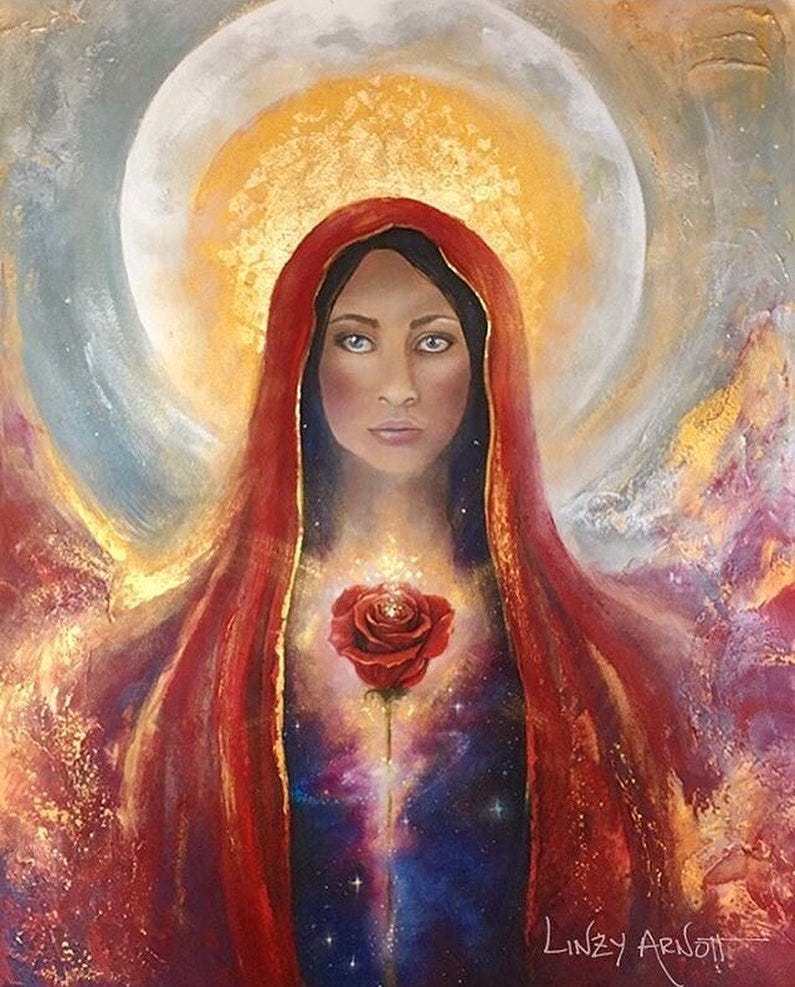
Artwork by https://www.linzyarnott.com/
The Same Wound, in My Own Blood
I know this move intimately, because a gentler version of it runs in my own line, and I have only lately understood how deep it goes.
I come from generations of servant women. Washerwomen. Housemaids. Women in service, some of them indentured, to the landed gentry of England. Women whose whole survival depended on knowing their place and never once reaching above their station. Do not want more than this. Do not imagine a bigger life than the one you were born into. That teaching goes down through the blood, mother to daughter, a careful dimming passed hand to hand across the centuries.
It is the same diminishing, only domestic. Gregory did it to the Magdalene with a sermon. History did it to my grandmothers with a class. Both did it for the one reason it is ever done. A woman who knows her own worth is very hard to command.
They did not need to burn all of us. For most of us, it was enough to convince us that we were small.
The Edge of My Own Worth
Which brings me to the awkward part, on her feast day.
I am nearly sixty. I have carried this work for thirty years, fifteen as a psychotherapist and fifteen as a teacher and priestess of this very lineage. And I have still been standing at the edge of my own worth, not quite daring to cross it.
There is a fuller, wilder, more visible version of what I am here to do. I can feel it pulling at me, insistent, and it frightens the life out of me. Because every single time I reach for it, some ancient and faithful part of me reaches instead for the smaller, safer, more predictable shape. The washerwoman’s caution. The Magdalene’s diminishing. The old voice that asks, in a tone so reasonable it sounds almost like wisdom, who do you think you are.
Who am I to want to stand fully in this. To take up that much room. To call myself teacher, priestess, initiate, out loud, in front of everyone. To reach, so visibly, above the place I was assigned.
That is the question. And the Magdalene, if we let her, is the answer to it.
What Her Power Actually Is
Because this is the part we so often get wrong. We imagine that claiming our power means growing hard. Grasping. Loud in the way frightened men are loud. It does not, and she never was.
Her power was of an altogether different order. She was an alchemist, and her elixir was love. She was an initiatrix, the one who anointed, who awakened, who looked at another soul and called its divinity up out of hiding. In the East they remember her as a Myrrhbearer, one who carries the sacred oils to tend both the living and the dead. Her power was the power to see, and to be seen, and to look away from neither. To love so fiercely she could stay present to all of it, the cross, the tomb, the unbearable, when every man there had run. To carry a truth in her own blood and breath and bone, and to speak it out loud without asking anyone’s permission. I see. I hear. I speak.
That is the power we were stripped of. Not domination. Sovereignty. The unshakeable knowing of your own worth, felt from the inside, that no pope and no master and no frightened man can reach in and rename. The power to want, and to reach, and to birth something luminous into the world through the sheer force of your presence, and to call it holy, because it is.
And yes, her power was erotic, in the true and enormous meaning of that word. Not performance. Life force. The current that pours through a woman who is all the way home in her own body, all the way alive, and no longer apologising for either. They had to call her a whore precisely because they could not bear how much life she carried, and how little of it she owed them.
I can hear how all of that reads, written down in daylight. A bit much. I mean every word of it anyway, in the most ordinary and embodied way I know how.
The Shadow I Had to Face
One thing caught me clean off guard, and I would rather own it than write around it.
For a long while, my own version of stepping up was to say, I do not need the light on me, I only want to shine it onto others. To help other women rise. And that is beautiful, and it is genuinely true. But coming from a line of servants, I have had to ask myself a harder question. Is that the healed woman speaking, or is it the servant’s oldest reflex in more spiritual robes? The light deflected off myself, one more time. Still not quite permitted to want it for me.
The Magdalene settles it. She did not empty herself in service. She stood equal. She claimed her own light first, wholly, without apology, and it was out of that overflowing fullness that she anointed anyone at all. There is the difference, and it is everything. The servant gives because she is not allowed to keep. The sovereign woman gives because she is brimming over. I am learning, at last, to fill first. To claim the light as mine, and then to turn it outward. Both. No longer one at the cost of the other.
To Be a Modern Magdalene
So this is what I have come to believe it means to be a modern Magdalene. It has nothing to do with costume, or claiming a title, or calling yourself special. It is quieter, and far more demanding, than that.
It is refusing the diminishing. Every single place the world made you small and taught you to be grateful for it, you go back, and you take your true size again.
It is knowing your worth from the inside, in the one place no one can reach in and rewrite it.
It is wanting, out loud. Reaching above the station you were handed. Being, without apology, too much for anyone who needs you small.
It is standing present to all of it, the beauty and the wreckage both, and staying in love anyway. That was the one power they were never able to take from her. It is the one this breaking world most needs from us now.
And here is the grace note, on her day. It took fourteen hundred years, but even Rome came back around. In 1969 the Church quietly untangled the lie, and in 2016 a pope raised her feast to the same rank as the male apostles, and named her again, in the old and rightful words, the apostle to the apostles. The truth outlasted the smear. It nearly always does.
We are the daughters of the women they could not burn, and the granddaughters of the women they could only silence. Their prayers are in our mouths. And today, on her feast day, I can feel the whole long line of them, the priestesses and the washerwomen both, leaning in to see what we will finally dare to want.
I am not done being frightened, my loves. I catch myself reaching for the smaller shape most weeks, and I daresay I will again next Tuesday. But I am done letting the fear cast the deciding vote. And I suspect, if you have read this far, you are getting there too.
So say her words with me, if you fancy it. I see. I hear. I speak. I am here now.
I am not going back to pretending I am smaller than I was made. Not on her watch. Not on mine.
So my rally cry for us all - is stop dimming ourselves, but more than that- to risk stepping into our own edges. The edges that would call us to heal these last vestiges of our own self worth, for this is a wound that is the most ancient one we carry. And my loves it isn’t even ours! It is the one that was given to us across many generations of women who have had to hide their power.
I am done with that. And Magdalene is here to offer her true story to us… on this day and every day that we call to her.
In love and devotion, Elayne Kalila

I am so blessed to be partnering the with Shift Network on my next Magdalene course. It begins in August and I would be delighted to walk beside you.
If you feel called to check it out here is the link.
Her story is the story of all women under patriarchy, all of us made to get back into our boxes until most of us forgot that the boxes were even there. I feel the diminishment, the shame, the fear that rises up in me when I try to expand to a fuller shape, a more true expression of my essence. ‘Don’t get too big for your boots,’ I hear my dead mother say. ‘Your head will get so big you won’t fit through the door,' she adds. Oh Mum, the box was always too small for you too.
I feel this to my core in a way words can’t fully capture. With deep gratitude and love I thank you for sharing this honest, humble and powerful testimony that calls on our sovereignty to come forth. I am here. ♥️🌹