Fathered
My father is disappearing, an ocean away, by stroke and then dementia. A Father’s Day letter about the long wait for him to see me, the gift of finally seeing him, and the gratitude I am left with.

The Disappearing
My father is leaving.
Not all at once, which would at least be a thing you could stand at the edge of and mourn cleanly. He is leaving the way the tide leaves, so gradually that you keep thinking it has stopped, and then you look up and another long stretch of him is simply gone. It was a stroke first, that took the first piece of him. Then the dementia came in behind it, and has been quietly carrying off the rest ever since. The names. The threads of a sentence. Most of his speech, lately. He still knows me. That much has stayed, and I am grateful for it past saying. But he has gone quiet now, and lives somewhere deep inside himself, behind eyes that still, thank God, warm when they land on me.
Dementia is a strange grief, my loves, and I did not understand it until I was inside it. You lose the person while they are still sitting in front of you. There is a name the researchers give it, the mourning of the living. They call it ambiguous loss. The grief with no funeral and no clean end, because the person is both gone and not gone, every single day.
And underneath it, where I expected only sorrow, I have found something else. A release. And lately, more and more, something even quieter and more surprising. Something close to peace.
The Dinner
Let me tell you about the last time I sat with him.
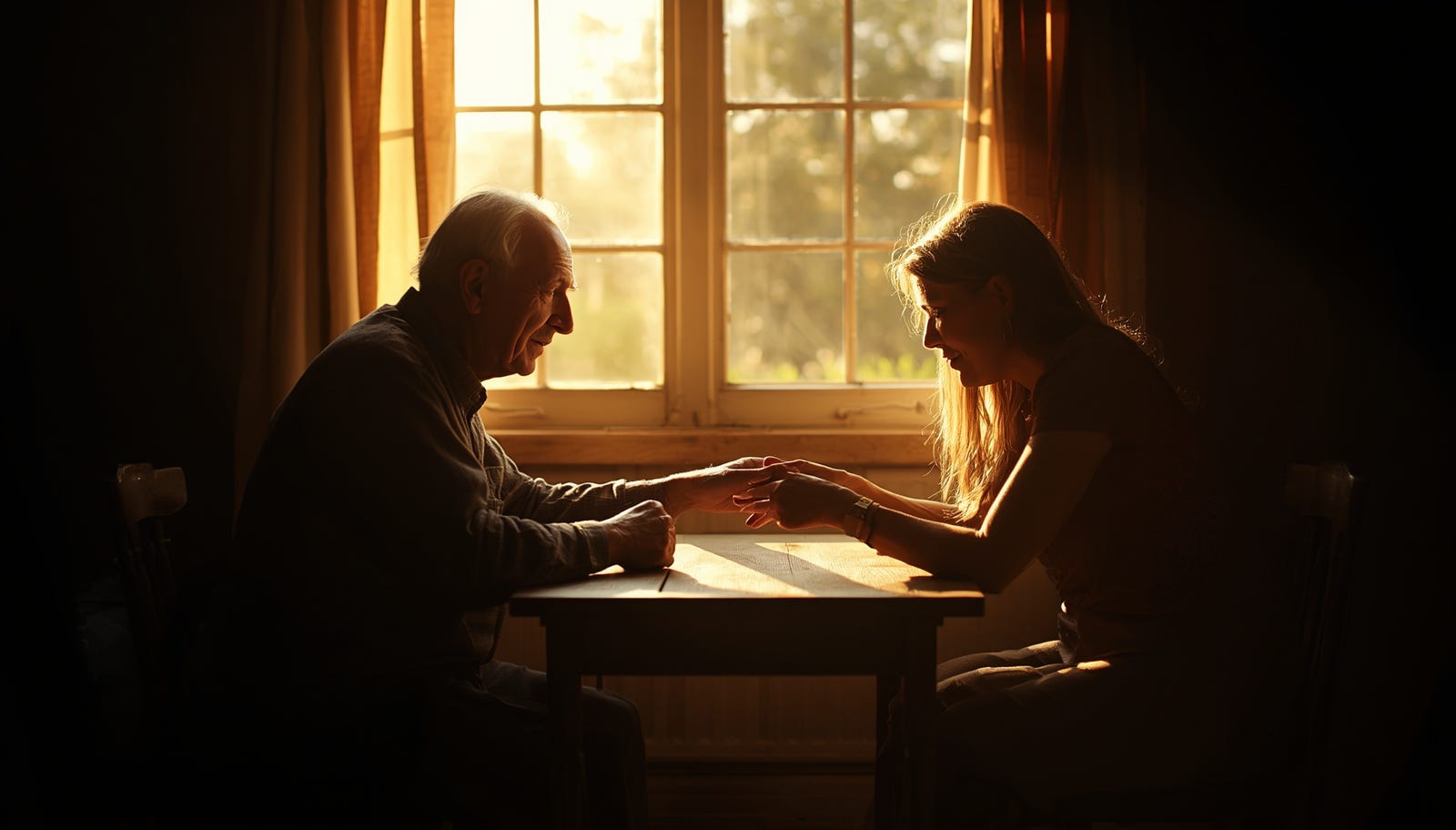
I flew back, over the ocean, last year, and we all went out to dinner together, our small family gathered round him. We sat and ate and he could barely find the words any more, and mostly just looked out at us. I felt how far back into himself he had gone. There was a version of me, not so long ago, who would have sat at that table with her heart breaking.
But at some point I reached over and took his hand. And I told him I loved him. I told him there was nothing but love here. Nothing he had to do, or say, or be. That we were all right, he and I. That it was all all right. And it was. It was so simple it astonished me. A hand, and a few plain words, and somehow the whole thing was complete.
And something dissolved in me that night that I had been carrying for the better part of thirty years.
What I Was Waiting For
Because here is what I had been carrying.
For most of my life there was a small and almost desperate hope beneath everything I built. That one day my father would truly see me. Not the version of me that was useful, or impressive, or easy to be proud of from a distance. Me. The actual one. I wrote about the wider version of this, in a piece I called Fatherless. About a whole culture of us raised by fathers who were present and absent in the same breath, there at the table and gone somewhere behind the eyes. My father was one of those. A good man in many of the ways that get counted, and behind the eyes, in the place I most wanted to reach, somewhere I was never quite let in. I knocked at that door for the better part of fifty years.
And there was one particular shape the longing took, one I have not said out loud to many people. He never came to see me. I built a whole life out here in America, thirty years of it, a life I was proud of, and he never once got on the plane. He never made it here. And for years, God help me, I let that mean the only thing a waiting child knows how to make it mean. That I was not worth the journey. That if he had truly loved me, he would have come.
I know better now. The truth, the one I can finally hold without it cutting me, is that my father loved me. He loved me the whole time, in the way that he was able. It simply was not the way I needed. Those are two different facts, and they are both true, and learning to hold them in the same hand has been most of the work of my middle life. He gave what he had. It was not what I was asking for. And he loved me. All of it, at once, true.
The day I was waiting for, when he would turn and see me whole and say the words, is not coming now. The stroke and the dementia have seen to that. That ship has sailed. And at that dinner, with his hand in mine, I understood that I had stopped needing it to come. The waiting had ended without my noticing, somewhere along the way, the way you finally set down a bag so heavy you had forgotten you were holding it.
The Gift
And in its place, the oddest gift of this whole long leaving.
The stroke took something. The dementia is taking the rest. But between them, they have taken the armour too. Whatever it was that kept my father contained and defended and just out of reach all those years, the emotional distance of a certain kind of man of his time, it has fallen away. He cries easily now. It frustrates him, I can see that it does, this new nearness of his own tears. But for me, I will be honest, it is a blessed relief. The feeling was always in there. I am simply, finally, allowed to see it.
Because that is the gift, the strange and holy joke of it. He may not be able to see me any more, not in the deep way I spent a lifetime waiting for. But I can finally see him. The seeing I was always longing to receive, I get to give instead. I get to look at my father, softened and open and at last unguarded, and see him clearly, and love exactly what I see. It is the wrong way round from how I always pictured it. It turns out to be more than enough.
Across the Ocean
Most of the time, of course, I cannot be there. The ocean sits between us, and I reach him the way the distance allows. On the calls. And in a quieter, deeper way I want to tell you about plainly, because it has become the truest thread between us.
Some of what holds me steady is plain science. Researchers at the University of Iowa found that people with Alzheimer’s go on feeling an emotion long after they have forgotten what caused it. The memory of a visit fades within the hour. The warmth it leaves behind stays. The emotional life, the lead researcher said, is alive and well. And doctors are beginning, at last, to study terminal lucidity, the way some people with advanced dementia surface near the very end, whole and clear for a moment. They cannot fully explain it. But it tells me what I have always known in my body. He is in there. The whole of him. The disease is a curtain. Not an erasure.
And the rest, I know the way I know my own name. We can reach one another without words. I believe it with my whole being, and more than believe it, I have lived it. The Telepathy Tapes devoted an episode to exactly this, to dementia, one called Alzheimer’s and Telepathy. In it, a man named Dan Goerke describes how his wife, Denise, lost her speech to early-onset Alzheimer’s, and how, as her words fell away, something else opened wide between them. He began to sense her. Wordlessly. Her thoughts and her feelings arriving whole, in her own unmistakable voice, from somewhere beneath the disease. And he was not the only one. Family after family told the same astonishing story. A connection that outlived the loss of language, and slipped below words into something older and truer.
I had been doing this with my own father long before I had a name for it. Reaching for him in the silence, and feeling him reach back. So from here, an ocean away, I still myself and I go to him, soul to soul, in the place beneath the wreckage of his memory, and I find him there. Every single time. The body forgets. The names go. The speech goes. The soul does not. The soul can be spoken to, and it answers. The part of him I am reaching for is precisely the part that nothing, not the stroke, not the dementia, not the whole grey Atlantic between us, will ever take.
The Letter Was Always to Me
Somewhere in all of this, with his hand in mine at that table and then carrying him home in my heart across the water, I finally learned the thing my own work has spent thirty years trying to teach me, the thing I held out for everyone but myself. The seeing I waited a lifetime for was never going to come from him. It was not his to give, not in the measure I needed. The one who had to turn at last and see me, and say the words, and mean them, was me.
So I say them now. To the girl who knocked at that door for fifty years, who became so capable and so bright in the hope that it might buy what love is meant to give for free. I see you. I see how hard you worked to be worth the journey. And it was never, not once, your fault that he could not make it. You can come home now. I have got you, and you do not have to earn a single thing.
That is the love letter. It was addressed to him for half a century. It turns out it was always meant for me.
What He Gave Me
And here is what I am left with, now that the longing has gone quiet. Not the long list of what he could not give. The list of what he did.
Because my father gave me a great deal, and these days, more and more, that is the man I think of. The wonderfully eccentric one. The one with the quirky, surprising laugh. The grafter, industrious to his bones, deeply and quietly capable, who could turn his hand to almost anything and usually did. The practical man who grew his own food and baked his own bread. The one who made his own wine, and went ballroom dancing of all the glorious things, and lost himself happily for years in vintage motorbikes and camper vans, in the particular obsessions that made him so completely and unmistakably himself.
That is who I think of now. Not the closed door. The whole, odd, capable, dancing, bread-making, wine-making man who stood behind it. I think of him and I find, to my own quiet surprise, that I simply enjoy him. That I am grateful. For his quirks and his graft and his strange and lovely passions and the life he built with his own two hands.
In this moment, sitting here with all of it, there is nothing left to be upset about. There is only a daughter, grateful for her father. That is where the long road has finally brought me, and I did not expect it, and it is the most peaceful place I have stood in a very long time.
The Fathers We Are Calling Forward
And yet, releasing my father into all this gratitude has not left me only with him. It has left me with a fierce new clarity about what we are missing in the world, and must call back.
Because the wound my father carried was never only his. He was handed it. A boy of his time, taught that feeling was weakness and tenderness was unmanly, that a father provides and protects and presides but does not, heaven forbid, weep at the table or say the words I love you, I see you, I am proud of you, out loud where they could be heard. He spent a whole life behind glass because someone had told him, long ago, that a man belongs there. It took a stroke and the unmaking of his mind to finally let him out from behind it. That is not a personal failing. It is a tragedy with a thousand years standing behind it.
So on this Father’s Day, my loves, I want to do more than grieve, and more than be grateful. I want to call something forward.
I want to honour the good men. The ones already doing it. The fathers choosing, often with no model of their own to work from, to stay present behind their own eyes. To see their daughters, and to say so, in words. To weep at the table. To bless their children out loud instead of leaving them a lifetime of guessing. To stand in a masculine that protects without imprisoning, that is strong enough to be tender, that uses its power to witness rather than to withhold. This is the noble masculine. It is not soft and it is not weak, and the world is quietly starving for it.
To those men, doing the unglamorous, history-altering work of being a father who can actually be reached: thank you. Every daughter you truly see is a fifty-year wait that some grown woman will now never have to endure. Every son you let watch you cry is a boy who will not have to wait for his mind to fail before he is allowed to feel. Keep going. We see you, even on the days the culture does not.
Father’s Day
So. Dad.
I am not waiting any more. Not because I gave up on you. Because I found the seeing in the one place it could ever have come from, and because, over a quiet dinner with your hand in mine, I stopped needing you to be anything other than exactly who you are. Which is my father. Eccentric, gentle, disappearing, and mine.
I cannot always be in the room. It is a deep pain in my life that an ocean sits between us as you go. But I have found there is a place I can reach you that no water touches and no disease can close, and I go there as often as I can, and I sit with your soul, and I am, in the only way left to me, the warm thing in your room.
And I say it now, out loud and in the silence both, the thing I came all this way to learn how to say. Thank you. For all of it. For everything you did give me, which turns out to have been so much more than I could see while I was still busy counting what you did not.
I see you, Dad. I am proud of you. I love you. There is nothing but love here.
And to every good man being called, this Father’s Day, to stand up and be reachable: so do we. So does the whole aching world. We are waiting for you at a door that, this time, is going to open.
In love and devotion,
Elayne Kalila
Tears..& a deep, exhausted joy… because it could have been, in major points, the mirror image of my father & me. Except that there were a few blazing-brilliant-funny moments —as Alzheimers dissolved the deep reserve & life-long emotional restraint he held, & specifically— this is important— his deep belief in, & adherence to, non-violence to others, even in speech (a commendable ethic)…. During one visit, when he was getting a bit foggy about who I was, much less the detailed circumstances of my life, I told him that I was ending the very long problematic relationship I’d had with (Not his name, but let’s call him—) Andrew. When he still had his memory & reason, Dad had followed every difficult twist & turn with calm, rational support. I wasn’t sure he would now recall the name. But he surprised me (& my mother) by sitting bolt upright, eyes focussed & blazing with anger & he snapped “Andrew!!?? (Sic) Hasn’t anyone run over that fool yet!!??? If not, why not!” I just about fell over with startlement —& laughter—& I blurted “Oh Dad, I just love you to bits!!” I felt so primally protected & loved unconditionally - not for anything i’d accomplished, but just because he cared what was happening in my life. My mother & I chuckled about this, long after he slipped away peacefully at 95.
Ah, but there is more: a visitation just after he died which I still cannot explain - of a droll & witty energy which also carried deep, uncompromising protective love—& which manifested physically -you might say, poltergeist-wise- in my house, 3 times over a few days after he died.. & then was gone. (Details too complicated & tender/private; what remains in my heart & soul to this day the unconditional fierce protective love it expressed in a very direct way. Perhaps, ‘next time around’, I will be the one giving this protective support to him… For now, I hold him in my heart & just love. 🌿
Elayne, this is incredibly beautiful! I lost my father in my early 20's and it's only in the last few years that I realize that the love was always there, but never spoken. I talk to him--although not often enough you've just made me realize. I was raised in that strong and silent era, too. I've begun to open to my daughter and son in the last very few years and am sincerely committed to continue to open. Your article has given me so much inspiration to do so! Thank you!